
The day Kalshi launched Combos — its parlay product — DraftKings stock dropped 12% in a single session. Two and a half billion dollars in market cap, gone. Not because Kalshi had that many users. Because Wall Street finally believed the threat was real.
This is the most important fight in American gambling since a 6-3 Supreme Court decision on May 14, 2018 ended a 26-year federal monopoly. What followed was a gold rush — and two companies ate most of the gold. FanDuel sits at roughly 44% of US sports betting gross gaming revenue. DraftKings at 34%. Together, they control about 78% of the market. That’s not a competitive market. That’s a toll booth.
And Kalshi just pulled up with a bulldozer.
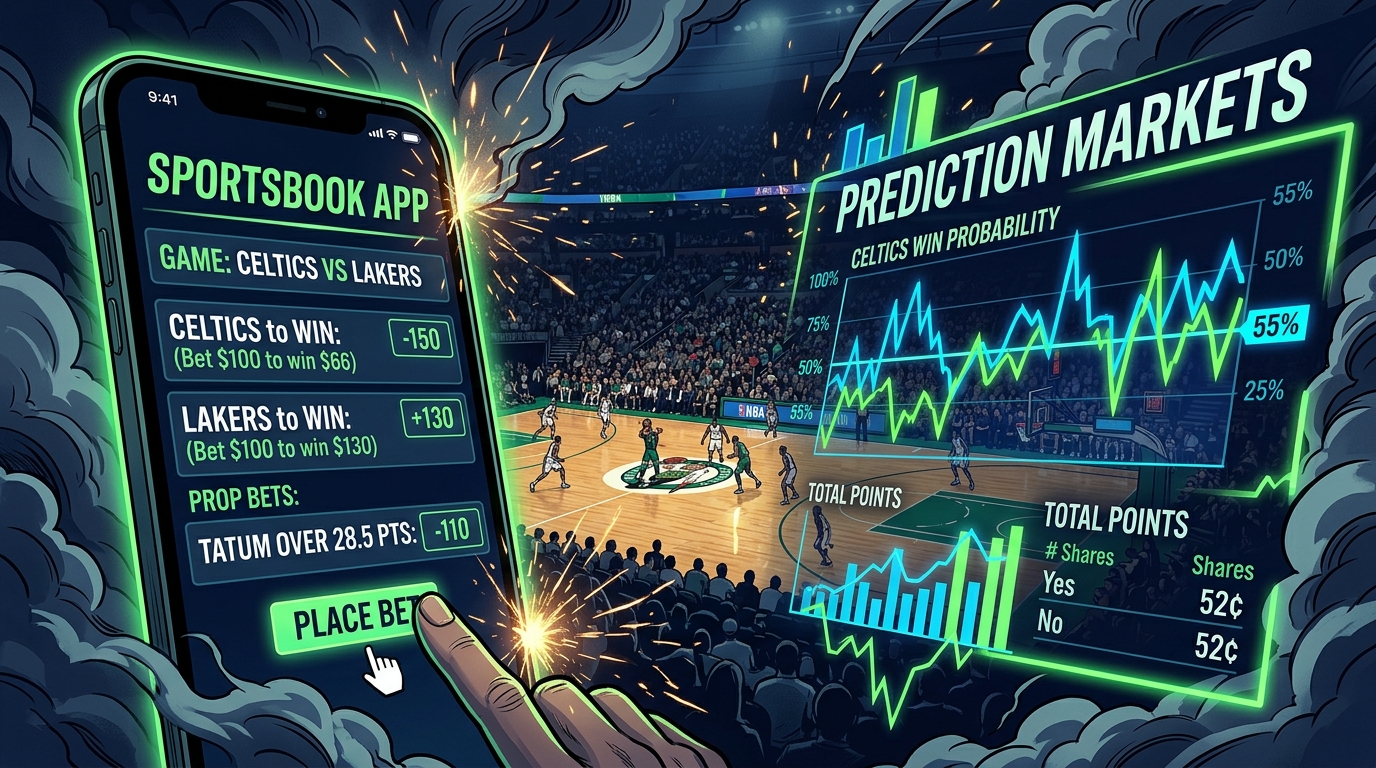
Here’s what makes prediction markets structurally different: sportsbooks set lines and absorb your action against the house. The vig is baked in — typically 4.5% to 10% depending on the market. They ban winners. They limit accounts. They profile you and shade the odds based on your history. Polymarket CEO Shayne Coplan didn’t mince it when he said “you can only trade against the house. They can ban you if you make money and they can profile you as a user and change the prices based on you. That’s a scam.” Harsh? Maybe. Wrong? Go ask anyone who’s had their DraftKings account limited to $10 maximums after a good run.
Prediction markets work differently. You’re trading binary contracts — yes/no, $0 to $1 — against other traders, not the house. Kalshi and Polymarket charge fees closer to 0.75% or less on sports contracts. The math versus a 10% hold is not subtle.
The bigger story is the regulatory angle. Kalshi operates under CFTC federal jurisdiction as a registered derivatives exchange. That means it doesn’t need a license in New Jersey, Illinois, or any other state. In April, the Third Circuit agreed, ruling New Jersey couldn’t block Kalshi’s sports contracts.
Then the Trump administration sued Illinois, Arizona, and Connecticut to stop them from regulating prediction markets at all. The CFTC chairman said the agency would “defend market participants against overzealous state regulators.” Donald Trump Jr., who has invested in Polymarket and advises Kalshi, presumably did not find this development surprising. This battle isn’t being fought on neutral ground.
What this means for your betting life right now: if you’re in California, Texas, or Florida — states where DraftKings and FanDuel still can’t operate legally — you can trade on Kalshi or Polymarket today. DraftKings Predictions launched in 38 states in December 2025, including California and Texas, because CFTC jurisdiction lets them operate where their sportsbook can’t. FanDuel launched its own prediction product three days later. They are simultaneously lobbying against prediction markets and building prediction market products. That tells you everything about how scared they actually are.
One honest caveat: a Citizens JMP analyst found median retail traders on prediction markets lose at about 8%, versus 5% on sportsbooks. You’re not competing against the house — you’re competing against sharp professional traders with no limits and lower fees. The same data shows that if you’re putting in $500K+ in volume, you have a positive ROI on prediction markets where you’d be negative on a sportsbook. So the question is which kind of bettor you are.
The sportsbooks aren’t sitting still. They pooled $48 million into a super PAC called “Win for America” targeting state legislatures ahead of the 2026 midterms. Bipartisan legislation — the Prediction Markets Are Gambling Act — was introduced in March to strip CFTC of authority over sports contracts. Nevada courts upheld a ban on Kalshi operations. Arizona filed criminal charges. This fight is not over.
But here’s what the sportsbooks cannot undo: they built their moat on state-by-state regulatory capture. Every new state meant a new license, a new lobbying campaign, a new revenue deal. For eight years, that worked perfectly. Kalshi and Polymarket found the door in the wall. The CFTC handed them a key. And a 12% stock drop on a parlay product launch suggests Wall Street isn’t betting on the incumbents winning clean.
 Betting Sports Blog